The next annual Knitting History Forum conference is on Saturday 7 February 2026, with presentations on the history of knitting. The conference is hosted online and tickets are available to purchase.
Susan Webster, collector and researcher of knitting tools, will present The development of circular knitting needles during the 20th century
The circular knitting needle is now an established tool among handknitters. But commercial production of circular needles is only about 100 years old. Before that, it was double points all the time. Susan Webster discusses the origin of early circulars in the UK and US, what they were made of, and how they were merchandised.
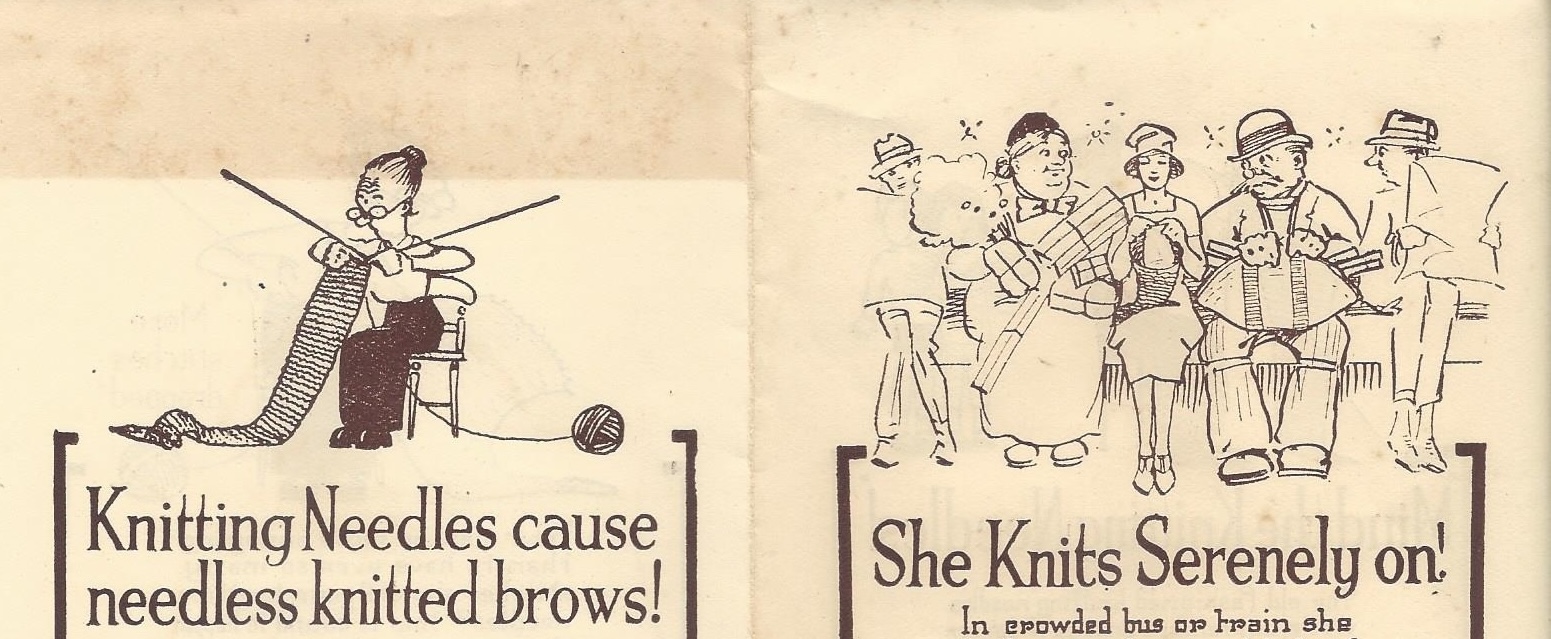
The earliest patents in the UK date to 1893 and 1906 and in the US to 1918. However, these registrations did not result in their immediate appearance in wool shops and haberdashery departments. Early UK packaging for Flexiknit and Abel Morrall’s Twin Pin gives patent dates of 1921 and 1922. Early circulars were all metal cables attached to short metal pins. Marketing messages accompanied these new, boxed products and claimed that circulars were modern, easier to use, less dangerous, and reduced the risk of losing a needle. US packaging – manila envelopes and cardboard backing sheets – was cheaper to produce. Americans used their own distinctive marketing, including differentiation of needle shape and materials, claims of design superiority, use of house-branding, and buying groups.
In the 1930s, American firms were offering rigid plastic circulars in parallel with metal circulars. The early materials such as celluloid and casein were easier to manipulate but the rigid plastics were hard to store and some were highly flammable. By the late 1930s, nylon and other flexible plastics had been developed, although all such innovations were soon sucked into war production. World War II had many effects on hand knitting tools such as no nickel-plating to prevent rust, no British sizing in the US for double points or circulars, and shortages of materials which forced reliance on “make-do and mend”. Soon after the war, flexible nylon circulars with metal pins and entirely nylon single piece circulars appeared. There were similar to the earlier rigid plastics but much more flexible. Few advances have been made in the basic tool since this era.
Biography for Susan Webster
Susan Webster is a collector of and researcher in knitting needles and tools, with a special interest in the period when commercialisation and branding of needles were being developed.
Susan grew up in the United States, but has lived her adult life in Australia. Retired since 2003, she has built up a research database of over 1000 knitting needle brand names and manufacturers, with about 900 physical specimens. She shares her information on her website www.knitting-needle-notions.com.au. Many of her articles and presentations are also available on this site.
Susan has published several research articles in the TCI Bulletin and in 2024-2025 completed a three-part series on the history of circular knitting needles. She has spoken and published in Britain and Australia too. She is a past president of the Needlework Tool Collectors Society of Australia.
She is still a keen collector. “The more you collect, the more you want to know,” she said.
Image credit: Promotional leaflet for Flexiknit (1920s), showing the old-fashioned knitter with her dangerous, slippery double pointed needles and the ‘modern girl’ with her circular needle