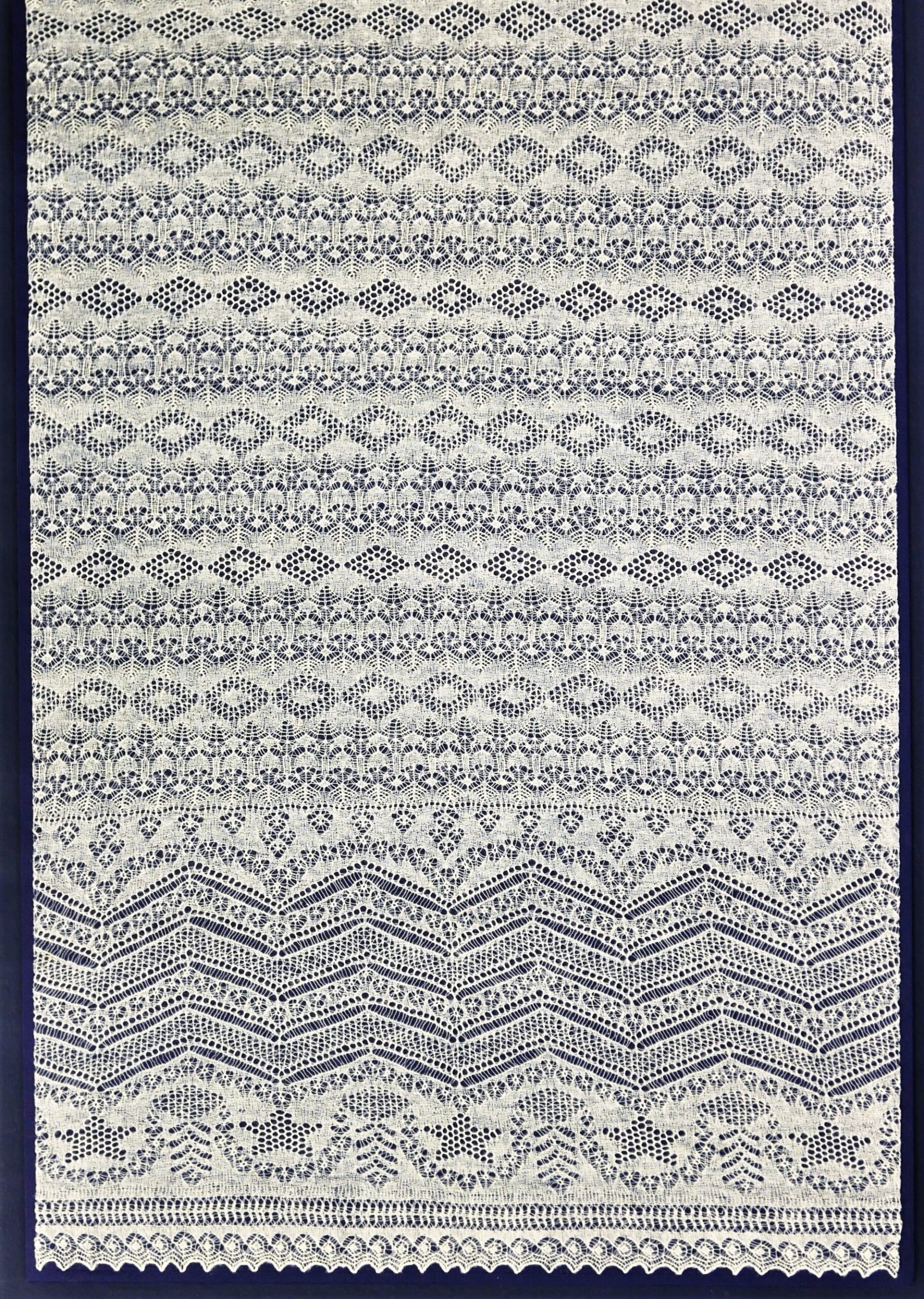
The next annual Knitting History Forum conference is on Saturday 7 February 2026, with presentations on the history of knitting. The conference is hosted online and tickets are available to purchase.
Carol Christiansen, Curator of Collections, Shetland Museum and Archives, will present Shetland Fine Lace Knitting: an overview of history and design
In the late 1830s, a form of extremely fine openwork knitting in wool emerged in a small community in the Shetland islands. Shetland Fine Knitted Lace would become part of the large international trade in fashion accessories and garments throughout the Victorian and Edwardian periods. At the same time, it challenged authors of early knitting pattern books and inspired the development of machine-knitted lace shawl manufacture in the British midlands. Carol Christiansen will explore the seemingly improbable origins and trade mechanisms of Shetland fine knitted lace, and the materials and skills required for its development. In particular, the preparation and spinning of very fine wool from the Shetland sheep breed was crucial to the success of knitting design and execution. The paper will set out the important role of the hand spinner as separate from the designer-knitter.
Surviving collections of Shetland knitted lace show a continuum of design principles, providing a way to define the craft. Primarily, motif placement and design complexity was dictated by Victorian fashion: how the garment would be worn against fashions of the day, showing off the most complex design areas of the garment as it was draped on the body. These will be illustrated with 19th century garments from Shetland Museum’s collection.
In the second half of the 19th century, the East Midlands began to develop machines which could produce fine shawls in openwork knitting. For a time, these garments were marketed as Nottingham-Shetland lace, in an attempt to mimic and undercut the hand knitting cottage industry in Shetland. This resulted in differences in design and manufacture.
Some lace knitters experimented with new styles, possibly as a result of commissions, keeping abreast of fashion from the 1850s into the first half of the 20th century. The change from designing and making two-dimensional garments to blouses beginning in the 1920s will be explored in light of a reliance on traditional Shetland knitting techniques to create three-dimensional lace garments in the round. The Victorian specialised craft continues to inspire people into the 21st century, from local makers to haute couture designers.
Biography for Carol Christiansen
Carol Christiansen has been Curator of Collections at Shetland Museum and Archives since 2006. She received her doctorate in Archaeology with a specialism in textiles from the University of Manchester in 2003. Her research on Shetlandic, Scottish, and Nordic archaeological and historical textiles has been published widely. She is the author of Taatit Rugs: the Pile Bedcovers of Shetland (2015) and Shetland Fine Lace Knitting: recreating patterns from the past (2024).
Image credit: Detail of a shawl (TEX 2004.303) given as a wedding present, Lerwick, 1921, Shetland Museum